
The Cornish Diaspora: Migration and Economic Change
Family history often reveals how wider economic changes shape the lives of ordinary people. In this case, research uncovered a Cornish mining family whose story reflects the large-scale migration of workers during the decline of mining in the 19th century.
For generations, the Taylor family of Cornwall were employed in the tin and copper mining industry, a trade that had formed the backbone of the local economy for centuries.
By the mid-1800s, however, the industry began to decline. Increasing competition from overseas mines led to falling metal prices, making many Cornish mines unprofitable, and as work became scarce, large numbers of miners and their families were forced to seek employment elsewhere.
This period of mass migration, now often referred to as the Cornish Diaspora, saw tens of thousands of people leave Cornwall in search of opportunities elsewhere, with many relocating within the United Kingdom, while others travelled much further afield.
Members of the Taylor family followed this pattern. Some moved to mining regions within England and Wales, working in ironstone and haematite mines, while younger generations began to look overseas.
By the late 19th century, several family members had travelled to South Africa, where new opportunities had emerged following major mineral discoveries.
In 1867, rich diamond fields were discovered at Kimberley, and in 1886, vast gold deposits were identified at Witwatersrand, transforming South Africa into one of the most significant mining regions in the world, with experienced miners being in high demand, and those from Cornwall, with their long-established mining skills, being one of the most recognisable groups within the workforce.
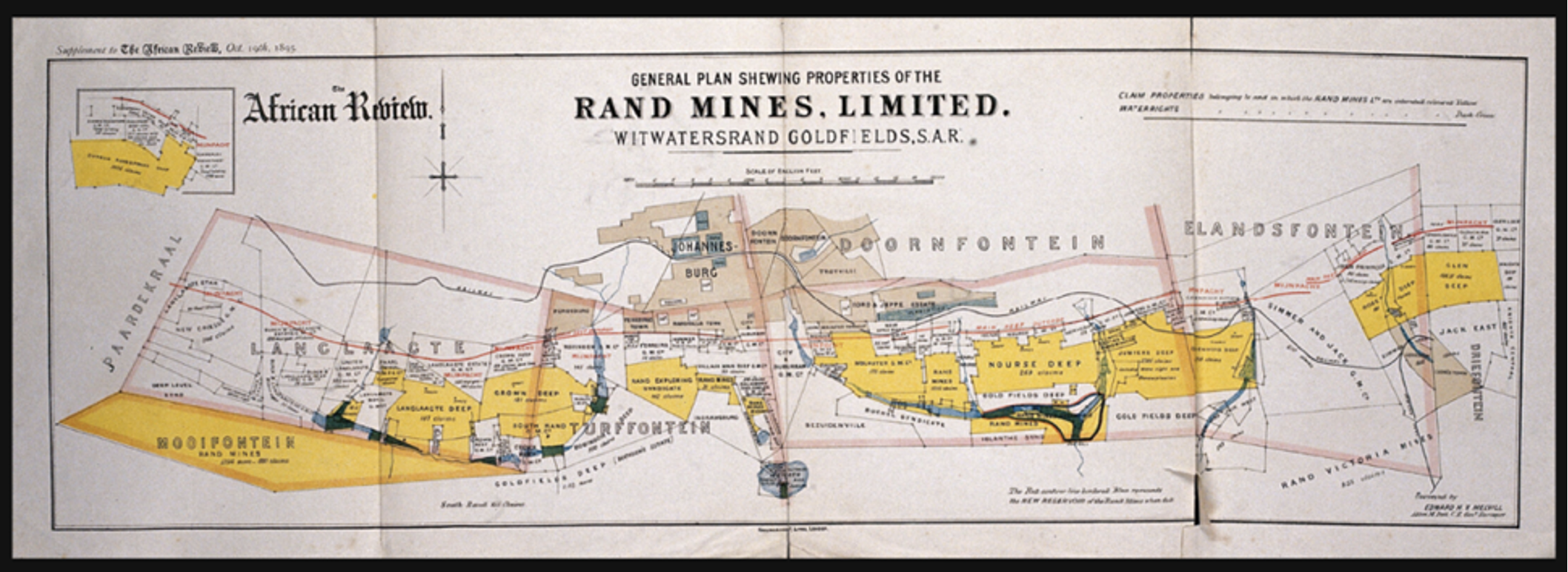
A map of Witwatersrand Goldfield, South Africa - 1895